
 WeHomeCare Family
 WeHomeCare Living
 WeHomeCare Connect
 WeHomeCare Campus
 WeHomeCare Omnibus
Family, independence and consent
What a care home is, and what everyday life there can include
How public bodies describe residential care, and what they say about belongings, daily routines, visitors and the person's own say in each.
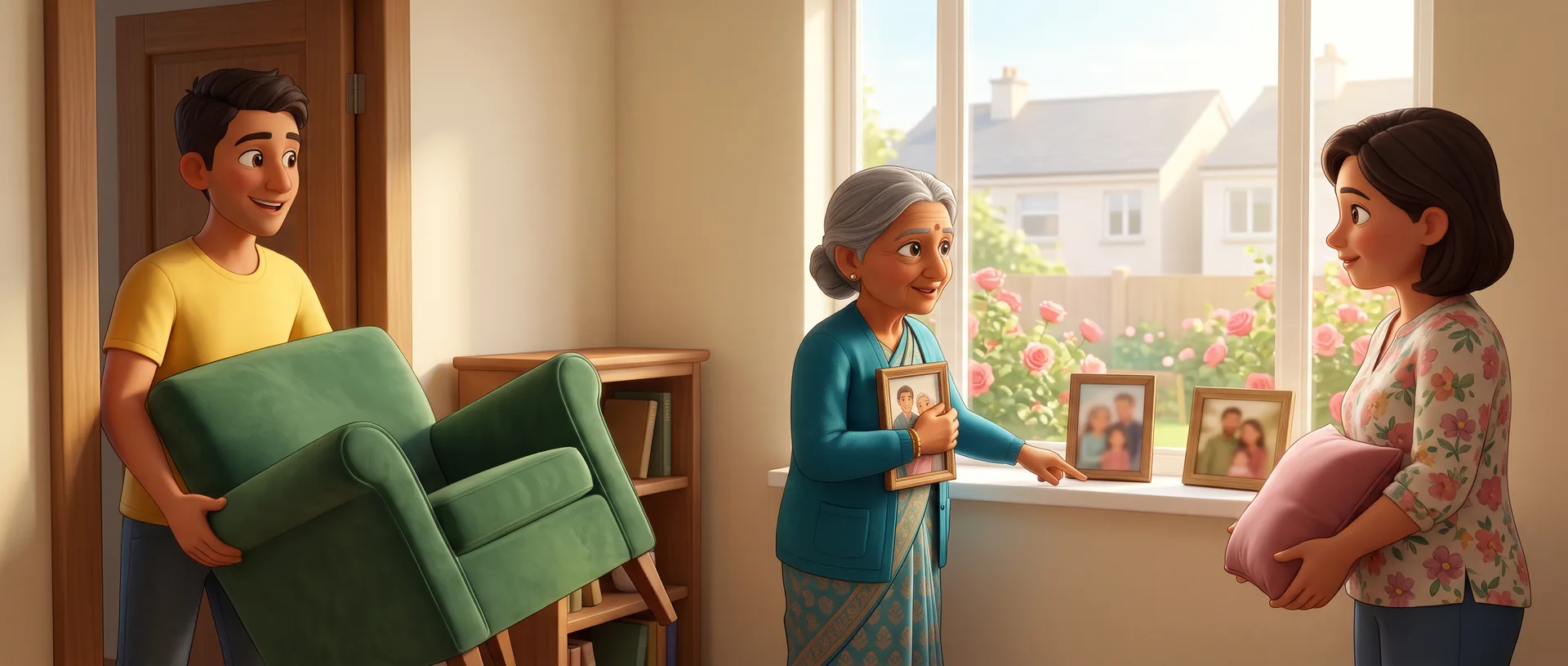
An armchair is tipped on its side to get it through a doorway, and someone is already deciding which windowsill the photographs will go on. Take this as information, not medical advice. It describes no particular home and says nothing about whether, or when, anyone moves into one.
A place to live, under different names
In Ireland, HIQA's national standards for residential care settings for older people describe a residential service as one providing accommodation with care and support to older people who live there. In Ireland, the HSE describes long-stay residential care as provided in nursing homes, both public and private. Health Canada says there is little consistency across Canada in what long-term care facilities are called, with names such as nursing home, personal care facility and residential continuing care facility.
In British Columbia, the provincial government uses the term "residential care facilities" and describes them as providing accommodation, meals, health care and supervision. In Alberta, the provincial government uses the term "continuing care homes". In England, the NHS uses "care home" for both residential homes, which provide accommodation and personal care, and nursing homes.
What a care home is called, and what it provides, differs by where the person lives. On this page, "care home" is a general word for a place where people live, rather than any one body's term.
What we don’t claim here
We don't rate care homes or centres, or say which one suits a person. That choice is the person's, with the people who know them, so we don't imply one.
Who can weigh it: the person, with their doctor or other health professionals, and the social care body where they live. Where to take it →
A room, and the things in it
In Ireland, HIQA's national standards for residential care settings for older people include, among the features of a service meeting its standard on privacy and dignity, each resident having a choice of a separate bedroom, where one is available, or of sharing a bedroom with another resident. Under the same HIQA standard, the features include personal possessions being respected and residents being helped to keep their personal belongings where possible. The same HIQA standard lists, among the features a service may include, an opportunity for each resident to be alone, "with due regard to their safety".
Routines, mealtimes and how the day is spent
Under their standard on residents' choice, HIQA's national standards in Ireland include each resident being encouraged to work out a structure to their daily life that reflects their own goals, activities and preferences. The same HIQA standards describe a service whose daily routines, including mealtimes and bedtimes, are set by residents' needs rather than the service's, and, under the standard on activities, respect for a resident's choice to opt out of communal activities, with other options offered that they may also choose not to take up.
Ontario's Ministry of Long-Term Care, in Canada, says that different long-term care homes offer a range of activities, from communal dining and social activities in the home to group outings, and that each resident has an individual plan of care. In British Columbia, the provincial government says a care plan in a residential care facility is developed together with the resident, their physician, and family members or other caregivers.
Visitors, faith and life beyond the building
Under their standard on relationships and community, HIQA's national standards in Ireland include each resident being helped to develop and keep personal relationships with family and others in line with their wishes, and being helped and encouraged to take part in their community. The same HIQA standards describe families and friends being welcomed by staff and taking part in the resident's life there, in line with the resident's wishes, and each resident being helped to observe or not observe religious practice, in line with their wishes. In England, the NHS says some care homes also offer activities, such as day trips.
These descriptions speak for Ireland, for Canada as a whole and for British Columbia, Alberta and Ontario, and for England. No official English-language source describing care homes turned up for the other provinces and territories, or for Thailand, during the work on this page; the public health or social care body where the person lives can explain how things work there.
A guide on a person's say over their own life goes further into choice. Anything about the person's own health in a care home is worth bringing to their doctor or care team, and how a place is arranged and paid for is taken up in the department on care systems, rights and support.
When to ask a professional
This piece stops where a professional's judgment starts. Health questions go to the person's doctor or other health professionals; questions about daily life go to the home or centre itself.
Sources
The outside sources this article draws on.
Primary: Taken from the official source itself, and cited directly.
- PrimaryHIQA (Ireland), National Standards for Residential Care Settings for Older People in Ireland, 2016
- PrimaryHSE (Ireland), Finding the right nursing home, no date shown, read 5 November 2026
- PrimaryHealth Canada (Canada), Long-term facilities-based care, no date shown, page read 5 November 2026
- PrimaryGovernment of British Columbia (Canada, British Columbia), Considering residential care, last updated 9 January 2026
- PrimaryGovernment of Alberta (Canada, Alberta), Continuing care: Overview, no date shown
- PrimaryOntario Ministry of Long-Term Care (Canada, Ontario), Living in a long-term care home, published 20 December 2021, updated 4 November 2025
- PrimaryNHS (England), Care homes, last reviewed 28 April 2026
WeHomeCare suites on this page
Related reading



More articles in this department
How we source
Carefulness, made visible.
Named, not counted
Each piece names its sources and tags each one Primary or Secondary. It never counts sources at you.
Holding back
Where a part isn’t confirmed, a piece runs shorter and says what is missing.
Naming the limit
Every piece names where its authority ends, and who to ask instead.